 EN
EN
 Dansk
Dansk  Deutsch
  Español
  Français
  Hrvatski
  Indonesia
  Italiano
  Magyar
  Nederlands
  Norsk
Norsk  Polski
  Português
  Română
  Suomi
Suomi  Svenska
  Tiếng Việt
  Türkçe
  Čeština
  Ελληνικά
  Русский
  Українська
  български
  ไทย
ไทย  日本語
日本語  简体中文
简体中文  한국어
한국어  עברית
עברית  العربية
 7 Best VPNs for Torrenting in 2026 (Fast & P2P-Friendly)

Many VPN services either block peer-to-peer (P2P) traffic or don’t have the server infrastructure needed for consistent, high-speed downloads. Without the right VPN features, your real IP address may be exposed, connections may drop mid-download, or your ISP may throttle torrent traffic.
According to our tests, the best VPNs for torrenting in 2026 are:
- Mullvad — Strong privacy, anonymous account setup, and a verified no-logs policy.
- ExpressVPN — Fast speeds, P2P support on all servers, and automatic obfuscation.
- NordVPN — High torrenting speeds, specialty P2P servers, and SOCKS5 proxy support.
- CyberGhost — Dedicated torrenting servers and easy-to-use automation features.
- Surfshark — Unlimited device connections, fast WireGuard speeds, and obfuscation tools.
- Private Internet Access — Port forwarding, flexible encryption settings, and advanced torrenting controls.
- Proton VPN — Open-source apps, audited no-logs claims, and reliable P2P support on paid plans.
A good VPN for torrenting should provide:
- P2P support — allows torrent traffic on dedicated or optimized servers
- Fast download speeds — maintains stable performance for large files
- Strict no-logs policy — prevents storage of identifiable activity data
- Kill switch — blocks internet traffic if the VPN connection drops
- IP and DNS leak protection — keeps your real location hidden
- Large server network — reduces congestion and improves connection stability
- Optional port forwarding — improves seeding and peer connections in some torrent clients
After testing 50+ VPN services, we identified providers that consistently delivered the features that matter most for torrenting: secure connections, stable speeds, reliable P2P support, and strong privacy protections during longer download sessions. You can get a clear side-by-side view of their features in our overview table.
What Are the Best VPNs for Torrenting in 2026?
1. Mullvad — Best for Privacy-First Torrenting With Anonymous Signup

 Try Risk-Free for 30 Days
Tested September 2026
| Best Feature | Privacy during signup; no email required, and accepts cash and crypto |
|---|---|
| Security and Privacy | RAM-only servers, multiple security audits, DNS/IP leak protection |
| Server Network | Smaller but effective network of 724 servers in 49 countries |
| Speeds | Fast but not always consistent |
Note: Do not use Mullvad to download or share copyrighted content illegally. vpnMentor does not endorse illegal torrenting.
Mullvad stands out for torrenting because it asks for almost no personal information and still supports P2P traffic across its entire network. You don’t need to provide an email address to create an account, and it also accepts privacy-friendly payment methods, including cash and cryptocurrency. That makes it a strong option for users who want to keep their VPN account as detached from their identity as possible.
Its torrenting performance was solid in our tests, even if it wasn’t always the fastest option overall. We downloaded a 700MB copyright-free movie in about 10 minutes without the VPN and in 16 minutes while connected to a US Mullvad server. In our broader speed tests, nearby servers reduced speeds by an average of 27%, while distant servers cut them by 39%. Those results are good enough for regular P2P use, but they were less predictable than the most consistent top-tier VPNs we evaluated.
 Nearby servers showed better performance
Where Mullvad really stands apart is how little user data it requires and retains. It has completed multiple independent audits, passed our IP, DNS, IPv6, and WebRTC leak tests, and uses RAM-only servers that clear data on every reboot. Overall, Mullvad feels more focused on protecting user privacy than on adding extra convenience features.
The trade-offs are worth knowing upfront. Mullvad’s server network is much smaller than those of several rivals, and our test results showed that speeds could vary more from one location to another. It also no longer offers port forwarding, which may matter to users who want better seeding performance or more control over peer connections. Customer support is another weak point since help is handled through email rather than live chat.
Best for:
- Users who want to share as little personal information as possible
- People who prefer a simple torrenting setup without hunting for special servers
- Anyone who values privacy more than extra features
Not ideal for:
- Torrent users who prefer VPNs with port forwarding support
- Anyone chasing the fastest and most stable results in every region
- Torrent users who want live chat support or more built-in tools
Why We Recommend It for Torrenting
- P2P on all servers: No need to search for torrent-friendly locations.
- Anonymous account setup: You can create an account without an email address.
- Leak-tested protection: It passed our leak tests during evaluation.
- Solid P2P speeds: Fast enough for regular torrenting.
- Independent audits: Backed by minimal data collection and multiple independent audits.
2. ExpressVPN — Best for Easy Torrenting With Fast, Stable Connections

| Best Feature | All servers conceal VPN traffic from ISP detection to prevent speed throttling |
|---|---|
| Security and Privacy | The kill switch cuts off internet access if the VPN drops, keeping your torrenting private |
| Server Network | All 3,000 servers in 105 countries support torrenting with no restrictions |
| Speeds | Excellent speeds with the Lightway protocol — only about 11% speed drop |
Note: Do not use ExpressVPN to download or stream copyrighted content illegally. vpnMentor does not endorse illegal torrenting.
ExpressVPN works well for torrenting because it combines strong speeds with a very simple setup. Since P2P traffic is allowed on every server, you don’t have to look for a special torrenting location before you start downloading. That makes it a practical choice for people who want fast, reliable performance without having to fine-tune a lot of settings.
From our experience, ExpressVPN was one of the most consistent options for longer P2P sessions. We downloaded the 1.76GB public-domain movie Night of the Living Dead in under 4 minutes on a UK server, which was only slightly slower than our regular connection. Across its broader network, speeds also stayed strong on both nearby and long-distance servers, so large downloads felt steady rather than erratic.
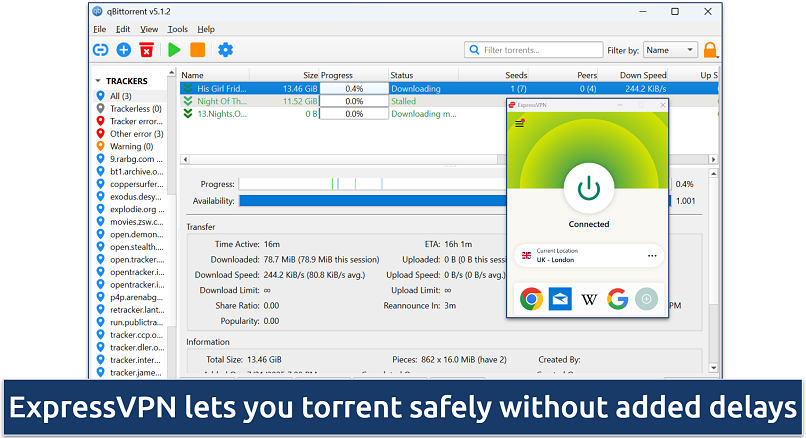 I recommend switching to Lightway TCP (instead of UDP) when torrenting on unstable networks
Another advantage is how well its network handles everyday use. Most of its servers run on 10 Gbps infrastructure, connections are usually established in a couple of seconds, and automatic obfuscation is built in across the network. That can help on school, work, public WiFi, or other networks where VPN traffic may be restricted or flagged. It also means you can usually just connect and start torrenting without switching protocols or hunting for the right server.
Privacy is another area where ExpressVPN performs well. Its RAM-only TrustedServer technology reduces the amount of data that can be retained, and its no-logs policy has been backed up both by independent audits and by the 2017 Turkish server seizure, where authorities reportedly found no useful user data. It is also based in the British Virgin Islands, which is outside the 14 Eyes intelligence-sharing alliances.
There are a few torrenting-specific limits to keep in mind. ExpressVPN doesn’t include SOCKS5 support, and port forwarding is only available through a router setup rather than directly in the app. It also offers less manual customization than options like PIA. On top of that, it’s still one of the more expensive VPNs in this category.
Best for:
- People who want to torrent on any server without extra setup
- Users who care most about speed and stable performance
- Anyone who needs automatic obfuscation on restrictive networks
Not ideal for:
- Those who want built-in port forwarding or SOCKS5 support
- Users who prefer more manual control over their torrenting setup
- Anyone mainly looking for the lowest-cost option
Why We Recommend It for Torrenting
- P2P on all servers: No need to switch to specialty torrenting servers.
- Fast real-world downloads: Large files finished with very little slowdown.
- Automatic obfuscation: Useful on networks that detect or restrict VPN use.
- Stable connections: Strong performance during longer download sessions.
- Verified privacy foundation: RAM-only servers, audits, and a court-tested no-logs policy.
3. NordVPN — Best for Fast Torrenting With NordLynx and SOCKS5 Support

| Best Feature | Download securely via the VPN or quickly with a SOCKS5 proxy |
|---|---|
| Security and Privacy | Dark Web Monitor alerts you if your private credentials are leaked |
| Server Network | 9,532 servers in 149 countries, including specialty P2P options |
| Speeds | Fast across all distances (average 23% speed drop) |
Note: Do not use NordVPN to download or share copyrighted content illegally. vpnMentor does not endorse illegal torrenting.
NordVPN is a strong choice for torrenting if your main priority is fast downloads with a setup that stays fairly simple. Its NordLynx protocol, built around WireGuard, delivered excellent performance in our hands-on evaluation, and its specialty P2P servers are easy to access from the app. It also includes SOCKS5 proxy support, which gives you a lighter option when you want IP masking without the full overhead of a VPN tunnel. That makes NordVPN a practical fit for users who want both speed and flexibility.
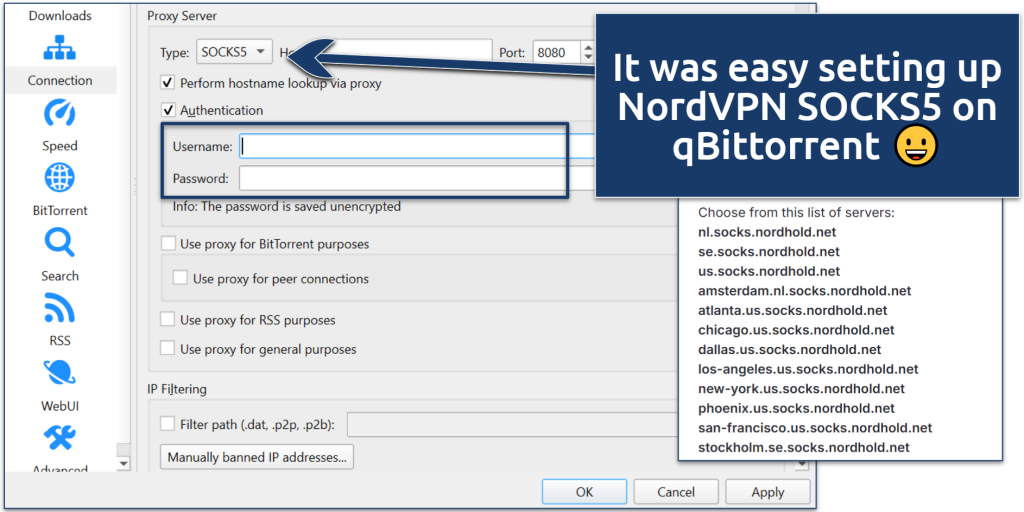 We didn't experience any major slowdowns while torrenting with NordVPN
In our experience, NordVPN handled larger downloads very well. We downloaded the 1.16GB public-domain movie Carnival of Souls in under 3 minutes, which was about the same as downloading it without the VPN connected. Performance also stayed strong across nearby and mid-range locations, especially in the US and Europe, where speeds remained high enough for smooth file transfers and stable long-session use.
Its network is another advantage. NordVPN has broad international coverage, a dedicated P2P category that removes some of the guesswork from server selection, and a Quick Connect feature that helps find a fast nearby location automatically. Regular servers can also handle torrenting, but the specialized P2P servers were more consistent in our testing. On the privacy side, NordVPN is based in Panama, uses RAM-only servers, runs its own DNS, and has a no-logs policy that has been independently audited more than once.
It doesn’t support port forwarding, so it’s not the strongest choice for users who care about seeding performance. Some distant servers can also take longer than expected to connect. And while NordVPN is technically strong, it is also heavily marketed, which means its reputation online can sometimes sound more exaggerated than its actual torrenting advantages justify. Overall, it’s a polished, high-performing option for torrenting, but not the most specialized one.
Best for:
- Users seeking very fast torrent downloads with minimal setup
- People who want both full VPN protection and SOCKS5 proxy support
- Anyone looking for a balance of speed, privacy, and ease of use
Not ideal for:
- Those who need port forwarding for better seeding
- Torrent users who want more advanced manual controls
- Anyone who wants the most specialized P2P feature set
Why We Recommend It for Torrenting
- NordLynx protocol: Delivers strong speeds for large downloads.
- SOCKS5 proxy support: Gives you a lighter alternative to a full VPN tunnel.
- Specialty P2P servers: Makes torrent-friendly servers easy to find.
- Wide server coverage: Helps you find a fast nearby connection.
- Strong privacy foundation: Panama-based, RAM-only servers, and audited no-logs claims.
4. CyberGhost VPN — Best for Beginner-Friendly Torrenting With Dedicated P2P Servers

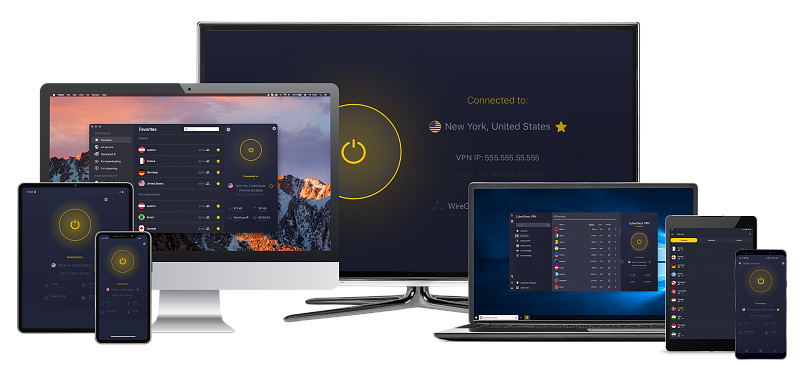
| Best Feature | Dedicated torrenting servers are built for stable, fast downloads |
|---|---|
| Security and Privacy | Headquartered in Romania (outside the 5/9/14 Eyes Alliance), for better privacy |
| Server Network | 11,690 servers in 100 countries provide uncrowded connections |
| Speeds | Very fast on nearby servers, but slower on servers far away |
Note: Do not use CyberGhost to download or stream copyrighted content illegally. vpnMentor does not endorse illegal torrenting.
CyberGhost is a strong option for torrenting if you want an easy setup and servers that are already organized for P2P use. Instead of making you sort through the full network, it separates torrenting servers inside the app (similar to NordVPN), which makes it easier to get started quickly. That makes CyberGhost a good fit for beginners and regular torrent users who want a smoother, more guided experience rather than a highly customizable one.
 CyberGhost's app clearly displays the user load percentage of each P2P server location
From our experience, CyberGhost delivered solid speeds for everyday torrenting. We downloaded a 1.1GB public-domain film in just under 2 minutes on one of its optimized servers, and in earlier hands-on use, a 4GB torrent on a Norway server also finished in under 3 minutes. Those results were close to our normal connection and felt steady during longer download sessions.
One of CyberGhost’s most useful features for torrenting is Smart Rules. This lets you automate the connection process so the VPN can launch and connect to a torrenting server when you open your torrent client. It also includes automatic WiFi protection, which helps reduce the risk of starting a session on an unsecured network. Together, those features make CyberGhost feel more beginner-friendly than many of the more technical VPNs on this list.
Its limits are fairly clear. CyberGhost doesn’t offer port forwarding, which may be a drawback for users who want better seeding performance or more direct peer links. It’s also not a strong choice for restrictive countries, and support has confirmed that it doesn’t work reliably in China. The monthly plan is less appealing too, since it costs much more than the long-term options and comes with a shorter refund period.
Best for:
- Less technical users who want easy-to-find torrenting servers
- People who prefer a simple app with minimal setup
- Users who want automation features for safer torrenting
Not ideal for:
- Those who rely on port forwarding for peer connections
- People who need a torrenting VPN that works reliably in restrictive countries
- Anyone focused on getting the best value from a short-term plan
Why We Recommend It for Torrenting
- Dedicated P2P servers: Easy to find and built for file sharing.
- Guided P2P setup: Makes torrenting easier without much trial and error.
- Smart Rules: Can connect automatically when you open your torrent client.
- Automatic WiFi protection: Helps secure torrent traffic on public networks.
- Audited privacy protections: Backed by a no-logs policy, Romanian-based headquarters, kill switch, and leak protection.
5. Surfshark — Best for Value and Unlimited Torrenting Devices

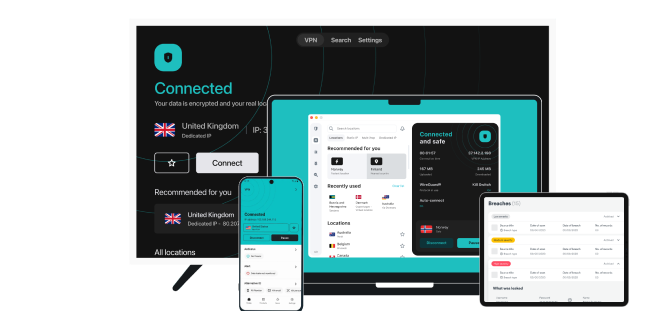
| Best Feature | Download on all your devices with unlimited connections |
|---|---|
| Security and Privacy | CleanWeb ad blocker removes ads and blocks malicious content on torrent sites |
| Server Network | Consistent performance across 4,500 servers in 100 countries |
| Speeds | Fast speeds on nearby locations and far away |
Note: Do not use Surfshark to download or stream copyrighted content illegally. vpnMentor does not endorse illegal torrenting.
Surfshark is geared toward torrenting across multiple devices under a single subscription. Since one plan includes unlimited simultaneous connections, it works especially well for households, shared setups, or anyone who downloads across several devices. Its long-term plans are also among the cheaper options in this group, which helps keep the overall value strong for users who want solid torrenting performance at a lower price.
In our hands-on use, Surfshark delivered good results for everyday P2P use. We downloaded a 2.5GB public-domain file in about 2 minutes on a UK P2P server, while the same file took around 4 minutes on a Netherlands location. We also connected several devices at the same time and didn’t notice any meaningful performance drop, which is one of Surfshark’s biggest advantages over most competitors.
 Surfshark has P2P-optimized servers in 70+ locations
Its privacy protections are solid too. Surfshark uses RAM-only servers, has an audited no-logs policy, includes a kill switch, and passed leak checks in the review. The main caveat is that it is based in the Netherlands, which is part of the 9 Eyes Alliance. That won’t matter to every user, but it’s still less appealing from a jurisdiction standpoint than services based in places like Panama or the British Virgin Islands.
Surfshark is less polished when it comes to torrent-specific usability. Not every server supports P2P, and finding the right ones is not as intuitive as it should be, even though the app can automatically move torrent traffic to a supported location. It also doesn’t work reliably in China.
Best for:
- People who want to protect multiple torrenting devices with one account
- Households or shared setups that benefit from unlimited connections
- Users looking for a lower-cost VPN with solid P2P performance
Not ideal for:
- Anyone who is highly concerned about 9-Eyes jurisdiction
- Users who want more advanced torrenting features or clearer P2P server selection
- People who need a VPN for torrenting that works reliably in China
Why We Recommend It for Torrenting
- Unlimited connections: Protects as many devices as you want under one subscription.
- Good everyday P2P speeds: Fast enough for large downloads and regular torrenting.
- WireGuard support: Helps maintain strong speeds with minimal setup.
- CleanWeb: Blocks ads, trackers, and some malicious links.
- Camouflage Mode: Helps disguise VPN traffic on more restrictive networks.
6. Private Internet Access (PIA) — Best for Performance Tuning and Port Forwarding

| Best Feature | Fine-tune your VPN settings for faster speeds or maximum security |
|---|---|
| Security and Privacy | Shadowsocks is a lightweight proxy that offers faster speeds with basic privacy protection |
| Server Network | 29,650 servers in 50 countries, including all US states |
| Speeds | Good speeds for downloading and uploading large files |
Note: Do not use PIA to download or stream copyrighted content illegally. vpnMentor does not endorse illegal torrenting.
PIA is aimed at torrent users who want more control over how their VPN connection behaves. It combines port forwarding, SOCKS5 proxy support, and flexible security settings, which makes it one of the strongest choices here for users who like to fine-tune their setup instead of relying on default settings.
From our side-by-side comparisons, PIA performed especially well on nearby servers. A 700MB file that normally took around 10 minutes to download finished in about 7 minutes with a nearby PIA connection, even with very few seeders available. Port forwarding can also help improve peer connectivity and seeding efficiency on supported servers, which is one of the main reasons PIA remains popular with more experienced torrent users.
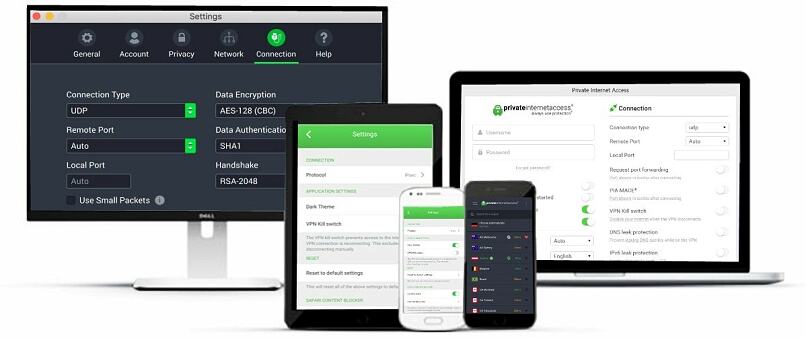
A big part of its appeal is flexibility. With OpenVPN, you can lower encryption from 256-bit to 128-bit if you want to prioritize speed, and the app gives you several protocol choices, split tunneling, multihop, and two kill switch modes. Its advanced kill switch is particularly useful for torrenting because it blocks all traffic unless the VPN is active, which helps reduce the chance of accidental exposure.
 MTU lets you choose the size of your data packets to customize your speeds for file downloads
It’s not the easiest VPN on this list to navigate. The interface is less polished than simpler rivals, and a lot of the extra settings will feel unnecessary if you do not actually plan to use them. Its speeds also hold up better on nearby servers than on long-distance ones.
Best for:
- Users who want port forwarding and SOCKS5 proxy support
- People who like adjusting encryption and protocol settings
- Torrent users who want more control over speed and peer connectivity
Not ideal for:
- Beginners who want the simplest app experience
- People who prefer a more streamlined interface
- Users who are uncomfortable with a US-based VPN
Why We Recommend It for Torrenting
- Port forwarding: Can improve seeding and peer connectivity on supported servers.
- SOCKS5 proxy support: Adds another option for users who want more setup flexibility.
- Customizable encryption: Lets you balance speed and security more directly.
- Advanced kill switch: Blocks traffic unless the VPN is active.
- Court-proven no-logs policy: Backed by audits and multiple real-world cases.
7. Proton VPN — Best for Transparent Privacy and Paid-Plan P2P Support

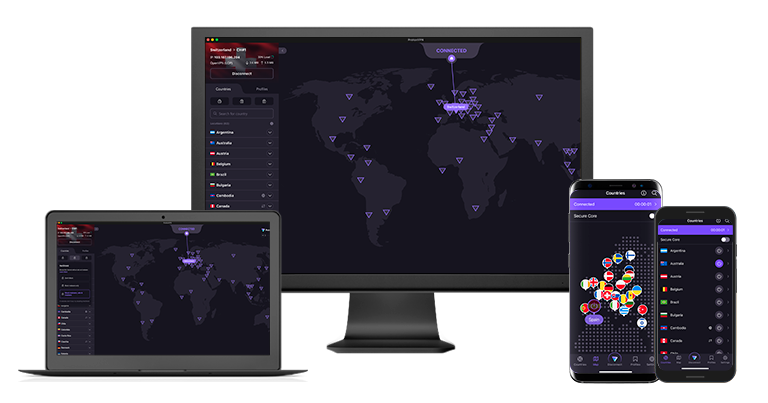
| Best Feature | Open-source app, independently audited, and based in Switzerland |
|---|---|
| Security and Privacy | IP/DNS leak protection, no-logs policy, Secure Core servers |
| Server Network | 20,412 servers in 148 countries for safe torrenting |
| Speeds | Fast nearby and a boost for long-distance with VPN Accelerator |
Note: Do not use Proton VPN to download or stream copyrighted content illegally. vpnMentor does not endorse illegal torrenting.
Proton VPN is a good match for torrent users who care most about a strong trust record, open-source software, and independently verified privacy claims. Its security model has been audited, and the service is based in Switzerland (outside the 5/9/14 Eyes Alliances), which gives it a stronger privacy reputation than many mainstream VPNs. It also passed DNS, IP, and WebRTC leak checks in the review, which adds more weight to its privacy claims.
 I tested multiple servers before torrenting, and none had IP leaks
In our evaluation, Proton VPN handled torrenting smoothly on its paid P2P-friendly servers. A 700MB file finished in about 14 minutes, which was roughly the same as the normal connection, and enabling port forwarding reduced that to around 10 minutes. The supported torrenting servers are clearly marked in the app, which makes them easy to find before starting a download. The free plan is more limited, though, since torrent traffic isn’t supported there.
Its paid servers also deliver stronger speeds than Proton VPN’s older reputation might suggest. Our testing recorded average speeds above 130 Mbps on paid servers, with WireGuard producing the best results. Some of its servers are built for up to 10 Gbps, and the VPN Accelerator feature can help improve longer-distance performance when enabled.
There are still some limits to be aware of. Torrenting is restricted to paid P2P-friendly servers rather than the full network, and Proton VPN doesn’t reliably work in China. It’s also not the cheapest long-term option if price is your main concern.
Best for:
- People looking for a provider with an established reputation
- Users who want open-source apps and audited security claims
- Torrent users on paid plans who want clearly marked P2P servers
Not ideal for:
- Anyone hoping to torrent on the free plan
- Users who want the cheapest long-term option
- People who need a VPN that works reliably in China
Why We Recommend It for Torrenting
- Open-source apps: Easier to inspect and trust than closed-source clients.
- Audited privacy claims: Supported by independent audits and a verified no-logs design.
- Paid-plan P2P servers: Clearly marked inside the app.
- Port forwarding: Can improve speeds on supported setups.
- Switzerland jurisdiction: More privacy-friendly than many rival locations.
How Do the Best Torrenting VPNs Compare?
- Mullvad: Privacy-first design and minimal signup data
- ExpressVPN: Speed and low-maintenance setup
- NordVPN: Fast downloads and flexible setup options
- CyberGhost VPN: Easy P2P setup and guided automation
- Surfshark: Lower-cost plans and multi-device use
- Private Internet Access: Advanced controls and port forwarding
- Proton VPN: Open-source apps and paid P2P access
The comparison table below highlights the torrenting features that matter most. Use it to quickly compare which VPN fits your P2P setup and privacy needs.
Note: Do not use the VPNs listed above to download or stream copyrighted content illegally. vpnMentor does not endorse illegal torrenting.
How We Tested and Ranked the Best VPNs for Torrenting
We ranked these VPNs based on the factors that are most important for torrenting:
- P2P support
- Download speeds
- Leak protection
- Kill switch reliability
- No-logs policies
- Ease of use
- Extra torrenting features, such as port forwarding, obfuscation, dedicated IPs, and SOCKS5 proxy support
To test performance, we downloaded large legal torrent files and checked how well each VPN handled longer P2P sessions. We looked at connection speed, stability, how easy it was to find a suitable server, and whether the apps worked smoothly on both desktop and mobile devices.
We also checked privacy and security directly. This included checking for DNS, IPv6, and WebRTC leaks, reviewing each provider’s logging policy, and verifying whether the kill switch worked properly during connection drops. Where possible, we checked for independent audits to confirm privacy claims rather than relying only on provider statements.
Support and usability also affected the rankings. We contacted customer support with torrent-related questions, reviewed response quality and wait times, and considered how easy each app was to use for beginners and more advanced users.
You can review our full testing methodology to see how we evaluate VPN speed, privacy, and P2P support across all services.
What Are the Risks of Torrenting Without a VPN?
Torrenting without a VPN can expose your IP address, slow your connection, and increase your risk of legal notices, tracking, and malware. A VPN reduces these risks by hiding your IP address, encrypting your traffic, and adding leak protection during P2P activity.
The main risks of torrenting without a VPN include:
- Your IP address is visible to other peers. When you join a torrent swarm, other users can see your real IP address. This makes it easier for third parties to trace the activity back to you.
- Your ISP can monitor or throttle torrent traffic. Internet providers often detect P2P activity and may slow your connection to manage bandwidth. That can lead to slower downloads and a less reliable torrenting experience.
- You may receive legal notices or warnings. In some countries, copyright monitoring groups track torrent swarms and flag IP addresses. Even if you are downloading legal files, being identified in torrent traffic can still lead to warnings or extra scrutiny.
- Torrent traffic is not encrypted by default. Most torrent clients don’t encrypt your connection in a way that hides your activity from your ISP, network administrator, or other observers.
- Public torrent sites can expose you to malware. Fake torrents, malicious files, and misleading download buttons are common on unverified torrent sites. Research shows that around 80% of pirate websites are hosted in countries with weaker intellectual property enforcement, which can make them harder to regulate and increase users’ risk of encountering unsafe or malicious content.1 Without strong protection, your device is more vulnerable to security threats.
- IPv6 leaks can reveal your real IP address. Some VPNs protect IPv4 traffic better than IPv6 traffic. If IPv6 is active and not fully protected, your real IP address can still leak during torrenting even when the VPN appears connected.
How To Fix Common VPN Problems When Torrenting
Most VPN torrenting problems can be fixed by switching servers, checking for leaks, enabling the kill switch, or adjusting your VPN settings. If torrenting is slow, blocked, or unstable, the issue is usually related to server choice, P2P support, or leak protection.
Common VPN torrenting problems and fixes include:
- Torrenting is slow or doesn’t start. Switch to a nearby server that supports P2P traffic. A distant, overloaded, or non-P2P server can reduce speeds or prevent downloads from starting.
- Your VPN doesn’t support P2P traffic on the current server. Some VPNs only allow torrenting on specific servers. Check your server list for locations marked as P2P or torrenting-friendly, or confirm with support.
- Your real IP address is leaking. Run an IP, DNS, and WebRTC leak test. If a leak appears, enable the kill switch, disable IPv6 if needed, and avoid browser-based torrent clients, which are more prone to WebRTC leaks.
- Torrent sites are blocked. Some ISPs restrict access to torrent trackers. Try an obfuscated or stealth server, clear your DNS cache, or switch to a private DNS provider such as 1.1.1.1 or 8.8.8.8.
- Port forwarding isn’t working. Make sure port forwarding is enabled in both your VPN and torrent client settings. Keep in mind that not all VPNs support it, and some require manual setup on desktop apps or routers.
- The VPN disconnects during downloads. Turn on the kill switch so your real IP address isn’t exposed if the connection drops. If disconnects keep happening, try a different protocol, update the VPN app, or switch servers.
If these fixes don’t solve the problem, contact your VPN’s support team. Many providers offer 24/7 live chat and can help troubleshoot torrent-specific issues based on your setup.
FAQs
Bottom Line
There is no single best VPN for every torrent user. The right choice depends on whether you care most about privacy, speed, ease of use, multi-device coverage, or advanced features like port forwarding and SOCKS5 support. The VPNs on this list performed well for different reasons, so the best option is the one that fits your priorities and torrenting setup.
Note: Do not use a VPN to download or share copyrighted content illegally. vpnMentor does not endorse illegal torrenting.
Sources
- https://zipdo.co/piracy-statistics/
- https://www.riaa.com/resources-learning/about-piracy/#:~:text=Criminal%20charges%20may%20leave%20you,and%20fines%20up%20to%20%24250%2C000
About the Author
Doris was a tech writer and a cybersecurity researcher for vpnMentor. She is enthusiastic about educating people about their rights to online freedom and provides actionable ways to protect their data.